Tuesday, October 13, 2020


Types of Volcanoes & Eruptions


mt eden

Mt Eden, Auckland.

Volcanic Fields
Volcanic fields, such as Auckland and Northland, are where small eruptions occur over a wide geographic area, and are spaced over long periods of time (thousands of years). Each eruption builds a new single new volcano, which does not erupt again. Mount Eden and Rangitoto Island are examples in Auckland.

Ngauruhoe

Ngauruhoe

Cone Volcanoes
Cone volcanoes (also called composite cone or stratovolcanoes) such as Ruapehu, Taranaki / Egmont and Ngauruhoe, are characterized by a succession of small-moderate eruptions from one location. The products from the successive eruptions over thousands of years build the cones.

Lake Taupo

Lake Taupo

Caldera Volcanoes
Caldera volcanoes, such as Taupo and Okataina (which includes Mt Tarawera), have a history of infrequent but moderate-large eruptions. The caldera forming eruptions create super craters 10-25 km in diameter and deposit cubic kilometres of ash and pumice.

Types of eruptions

Multiple types of eruptions can occur at each of New Zealand’s volcanoes - the eruption type can vary minute to minute. The style of eruption depends on a number of factors, including the magma chemistry and content, temperature, viscosity (how runny the magma is), volume and how much water and gas is in it, the presence of groundwater, and the plumbing of the volcano. 

Hydrothermal eruption
An eruption driven by the heat in a hydrothermal systems. Hydrothermal eruptions pulverise surrounding rocks and can produce ash, but do not include magma. These are typically very small eruptions

Phreatic eruption
An eruption driven by the heat from magma interacting with water. The water can be from groundwater, hydrothermal systems, surface runoff, a lake or the sea. Phreatic eruptions pulverise surrounding rocks and can produce ash, but do not include new magma.

Phreatomagmatic eruption
An eruption resulting from the interaction of new magma or lava with water and can be very explosive. The water can be from groundwater, hydrothermal systems, surface runoff, a lake or the sea.

Lava
Lava is molten rock erupted at the ground surface. When molten rock is beneath the ground, it is called magma.

  • Lava flows are the effusive (non-explosive) outpourings of lava, and usually flow slower than walking pace. Lava flow types include a’a, blocky and pahoehoe.
  • Lava fountains are a fountain of runny lava fragments from a vent or line of vents (a fissure). They can form spatter piles, and if the fragments accumulate fast enough, they can form lava flows.
  • Lava domes are mounds that form when viscous lava is erupted slowly and piles up over the vent, rather than moving away as a lava flow. They are generally caused by viscous, thick, sticky lava that has lost most of its gas. They can range in volume from a few cubic metres to cubic kilometres.

Strombolian and Hawaiian eruptions
These are the least violent types of explosive eruptions. Hawaiian eruptions have fire fountains and lava flows, whereas Strombolian eruptions have explosions causing a shower of lava fragments.

Vulcanian eruptions
Vulcanian eruptions are small to moderate explosive eruptions, lasting seconds to minutes. Ash columns can be up to 20 km in height, and lava blocks and bombs may be ejected from the vent.

Subplinian and Plinian eruptions
Eruptions with a high rate of magma discharge, sustained for minutes to hours. They form a tall, convective eruption column of a mixture of gas and rock particles, and can cause wide dispersion of ash. Subplinian eruption columns are up to 20 km high, and are relatively unsteady, whereas Plinian eruptions have 20 to 35 km tall columns which may collapse to form pyroclastic density currents (PDC’s). Very rare Ultraplinian eruptions are even larger and have a higher magma discharge rate than Plinian eruptions.


Tuesday, September 22, 2020


Total station


A total station is an electronic/optical instrument used in modern surveying and building construction that uses electronic transit theodolite in conjunction with electronic distance meter (EDM).It is also integrated with microprocessor, electronic data collector and storage system.

The instrument is used to measure sloping distance of object to the instrument, horizontal angles and vertical angles. This Microprocessor unit enables for computation of data collected to further calculate the horizontal distance, coordinates of a point and reduced level of point.

Data collected from total station can be downloaded into computer/laptops for further processing of information.

Total stations are mainly used by land surveyors and civil engineers, either to record features as in topographic surveying or to set osut features (such as roads, houses or boundaries). They are also used by archaeologists to record excavations and by police, crime scene investigators, private accident Reconstructionist and insurance companies to take measurements of scenes.

total station


Wednesday, September 16, 2020


Earthquake 

Earthquake is the most dangerous natural phenomenon that generates sizable destruction in structures. It is reported that two sources of mistakes which would seriously endanger structures are ignoring the ways an earthquake affects buildings and shoddy construction practices. That is why a proper understanding of the seismic effects on a structure is extremely important, and designers and contractors should consider the influence of seismic forces on buildings in order to be able to set prevention measures against failures and collapses. As earthquake hits structures, it generates inertia forces which could be greatly destructive causing deformations and, horizontal and vertical shaking. These effects are discussed and presented below.
What are the Effects of Earthquake on Structures?

1. Inertia Forces in Structures

The generation of inertia forces in a structure is one of the seismic influences that detrimentally affect the structure. When an earthquake causes ground shaking, the base of the building would move but the roof would be at rest. However, since the walls and columns are attached to it, the roof is dragged with the base of the building.The tendency of the roof structure to remain at its original position is called inertia. The inertia forces can cause shearing of the structure which can concentrate stresses on the weak walls or joints in the structure resulting in failure or perhaps total collapse. Finally, more mass means higher inertia force that is why lighter buildings sustain the earthquake shaking better.
Fig. 1: Direction of Inertia Forces

Fig. 2: Development of Great Inertia Forces in the Six Storey of Imperial County Services Building

2. Effect of Deformations in Structures


When a building experiences earthquake and ground shaking occurs, the base of the building moves with the ground shaking. However, the roof movement would be different from that of the base of the structure. This difference in the movement creates internal forces in columns which tend to return the column to its original position.

These internal forces are termed stiffness forces. The stiffness forces would be higher as the size of columns gets higher. The stiffness force in a column is the column stiffness times the relative displacement between its ends.
Fig. 3: Lateral Force Resisting System in a House

3. Horizontal and Vertical Shaking


Earthquake causes shaking of the ground in all the three directions X, Y and Z, and the ground shakes randomly back and forth along each of these axis directions. Commonly, structures are designed to withstand vertical loads, so the vertical shaking due to earthquakes (either adds or subtracts vertical loads) is tackled through safety factors used in the design to support vertical loads.

However, horizontal shaking along X and Y directions is critical for the performance of the structure since it generates inertia forces and lateral displacement and hence adequate load transfer path shall be provided to prevent its detrimental influences on the structure.

Proper inertia force transfer path can be created through adequate design of floor slab, walls or columns, and connections between these structural elements. It is worth mentioning that the walls and columns are critical structural members in transferring the inertial forces. It is demonstrated that, masonry walls and thin reinforce concrete columns would create weak points in the inertia force transfer path.
Fig. 4: Principal Directions of a Building

Fig. 5: Load Path for Lateral Inertia Forces

4. Other Effects

Apart from the direct influences of earthquakes on a structure which are discussed above, there are other effects such as liquefaction, tsunami, and landslides. These are the indirect effects of strong earthquakes that can cause sizable destruction.

Tuesday, September 01, 2020


solid waste management process


The term solid waste management mainly refers to the complete process of collecting, treating and disposing of solid wastes.

In the waste management process, the wastes are collected from different sources and are disposed of. This process includes collection, transportation, treatment, analysis and disposal. It needs to be monitored so that strict regulations and guidelines are followed.

Sources of Solid Wastes

  • Solid domestic garbage.
  • Solid waste material from various industries.
  • Solid agricultural waste.
  • Plastics, glass, metals, e-waste, etc.
  • Medical waste.
  • Construction waste, sewage sludge

The process of waste handling and disposal varies in different countries. In India, the processes differ according to the source of solid waste. They can be classified as:

⦁ Municipal Solid Waste.
⦁ Hazardous Solid Waste.

Municipal solid waste can further be divided into biodegradable, recyclable and hazardous domestic wastes. The biodegradable waste includes rotten food, vegetable peel and mostly wet kitchen waste. Recyclable waste includes plastic and hazardous wastes include, bulb, batteries, etc.

The industry generated like chemical factories, medical waste from hospitals are considered as Hazardous Solid Waste and needs special settings to dispose of them.

In any region, solid waste management is very important for the safe disposal of wastes and to reduce environmental pollution and avoid any health hazards that it may cause.

Landfills are the most common method of disposing of solid wastes. Modern-day landfills are designed by taking care of various environmental factors and types of wastes, so as to minimize pollution and health risks.


Monday, August 31, 2020


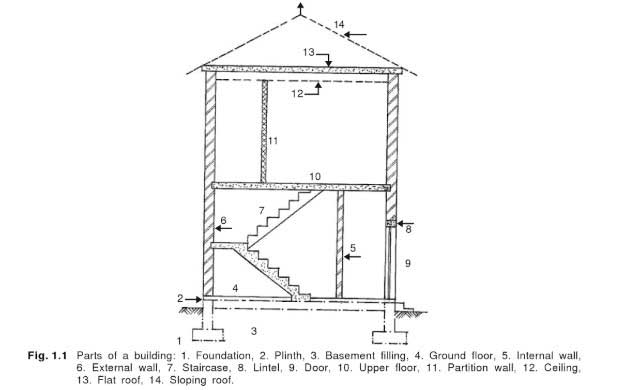
Parts of a Building


They are as follows:

1. Foundation,

2. Plinth,

3. Walls and columns,

4. Floors,

5. Lintels and chajjas,

6. Roof,

7. Doors and windows,

8. Stairs and lifts,

9. Finishing work (plastering and painting),

10. Building services,

11. Fencing and external works.,


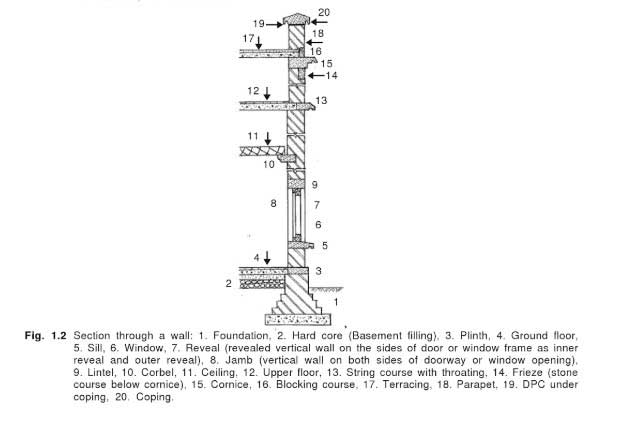
A building can be divided into substructure (foundation) and superstructure, the plinth level being the dividing line between them.


In building construction, we study how the civil works are carried out in the field after they have been planned by an architect and structurally designed by an engineer.

We should be aware that many aspects are involved in the preliminary planning and design of buildings.

For example, an architect specializes in the following works:

1. Planning the orientation, layout, and dimension of the rooms of the building

2. The preparation of the features to make the building attractive.

Work of this nature for small buildings may be taken by non-architects also.

However, the construction of a building should always be carried out under the supervision of a qualified person.

We will now briefly examine the construction of the different components of a building.
1. Foundation.

Foundation is a very important part of a building.

All the loads of superstructure are transmitted to the foundation.

A foundation engineer should know how to examine the soil profile and arrive at a suitable foundation.

The following are some of the different types of foundation generally used:

1. Strip foundation (shallow foundations)

2. Footing foundation (shallow foundations)

3. Raft foundation (shallow foundations)

4. Pile foundation (deep foundations)


5. Pier foundation (deep foundations).

In framed construction, we use footings as the foundation for the column and the brickwork for walls starts from grade beams connecting columns.

(Grade beams on under-reamed piles are also called capping beams).
Read Also: Unit Weight of Building Materials [A Complete List].
2. Plinth

The plinth is a dividing line between the substructure and superstructure.

Thus, the projecting part of the wall above the ground level to the floor level is the plinth.

The plinth is usually kept at least 45 cm (1.5 ft) above the general ground level of the building.
3. Plinth Beam.

It is capped by a beam called plinth beam.

The provision of a plinth beam and damp-proof course at plinth level are very important in building construction.
4. Damp Proof Course (D.P.C).

The damp proof course is a layer provided in building to prevent the entering of dampness from the ground to the building components.
5. Walls and Columns.

Walls are mostly made of masonry.

It may be of brick, block-work, stonework, etc.

Buildings may also be constructed as a framed structure with columns and footings and
then Walled.

Most of the flats and high-rise buildings are built this way.

In many places in the masonry, we use arches and lintels.
6.Floors.

Floor is an important part of a building.

It is the place where the inhabitants perform their most activities.

It is constructed on the filling and laid over the plinth level.

Floors are usually made from different types of materials, such as, timber, brick, R.C.C.

Top floors are nowadays usually made of reinforced concrete.
Read Also: Fineness Test of Cement; Its Apparatus, Procedure.
7. Roof.

A roof is an important part of all buildings.

The most important item in housing is to have a “roof over one’s head.”

A roof is a layer which covers the structure from the top.

It also prevents the building and inhabitants from the ill effects of the environment.

Depending on the finances available and also the climatic conditions, we can have different kinds of roofs.

Roofs can be sloped or flat.

Many types of roofs and roofing materials are available nowadays.
Watch the video below for better understanding.


8. Fabrication of Doors and Windows.

Openings are necessary in buildings for passages inside and outside the buildings.

We also need windows for lighting and ventilation.

A detailed study of doors and windows is an important part of building construction as the expenditure on this item alone can go up to 15 to 20 percent of the total cost of civil works.

Traditionally, doors and windows were made of wood and hence, this work is sometimes referred to as woodwork in buildings.

Other woodworks like provision of cupboards are also important, but it comes under the subject of interior decoration.
Read Also: Construction Specifications; Its Types, Importance.
9. Stairs and Lifts.

Nowadays most buildings are made more than one storey high.

Which means there should be a way to go from one storey of the building to another.

Knowledge of various elements of a staircase and the construction of a simple staircase is essential to all those involved in building construction.

Study of the layout and design of ornamental staircases is a special subject.

Usually, vertical transportation devices like electric lifts are to be provided in buildings having more than four floors including the ground floor.

We must also be familiar with these devices.
10. Building Finishes.

The final appearance of a building depends very much on its finishing.

We have to deal with the following:

1. Plastering and pointing

2. Painting of walls, woodwork, grillwork, etc.

It is essential that we have a knowledge of the finishing to be used on the various materials of construction such as plaster, wood, metals, etc.
11. Building Services.

Water supply, drainage, sanitation, electric supply lifts, external works, construction of cupboard, etc. are considered as items outside of civil works and are called building services.
Water supply, drainage, and sanitation (building service).

These works are considered separate from civil works and are also estimated separately.

Design and details of these will be studied in public health engineering under building services.

However, an elementary treatment of the subject is always included in basic building construction.

Wednesday, August 12, 2020


Fluid and its type

Fluids undergo continuous deformation, i.e. fluids always keep flowing. To define fluid, it is a substance that does not possess a definite shape and easily yields to external pressure. Fluid is any liquid or gas or any material that is unable to withstand a shearing or tangential force, when at rest. When the said forces are applied to the fluid, it goes through a continuous change in shape. Fluids are substances with zero shear modulus, i.e they cannot resist the shear force applied to them.

In our day-to-today life, we would have heard the dehydrated patient advised to consume more fluids to compensate for the water loss. Fluids help in the digestion of food, hence we need to take more fluids.

Classification of Fluids

Fluids are classified into four types depending on its flow, they are:Steady or unsteady
Compressible or incompressible
Viscous or non-viscous
Rotational or irrotational

Steady fluid: It is the fluid whose density remains constant at each and every point while flowing.

Unsteady fluid: It is the fluid whose velocity differs between any two points while flowing.

Compressible fluid and incompressible fluids: These are classified based on the mach number. The incompressible fluid has mach number<0.3 and the compressible fluid has mach number between 0.3 and 1.

Viscous or Non-viscous

Fluids with more thickness or viscosity are known as viscous fluids, they are generally very gloppy fluids. Examples: shampoo and motor oil.

Fluids with comparatively less thickness or viscosity are known as non-viscous fluids. These are the fluids with no resistance or negligible resistance to internal friction. Non-viscous fluids flow without any loss of kinetic energy.

Example: Superfluid liquid helium


Sunday, August 09, 2020


SOIL FORMATION 

                                            by Mr.Bright Brabin Winsley J


Soils differ from one part of the world to another, even from one part of a backyard to another. They differ because of where and how they formed. Climate, organisms, relief (landscape), parent material and time are five major factors of interaction creating different types of soils.

Climate: Temperature and moisture influence the speed of chemical reactions, which in turn help control how fast rocks weather and dead organisms decompose. Soils develop faster in warm, moist climates and slowest in cold or arid ones.

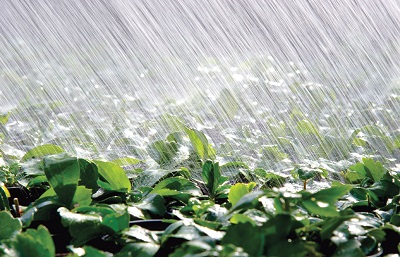
Rainfall is a part of climate
Rainfall is one of the most important climate factors in soil formation.

Organisms: Plants root, animals burrow, and bacteria eat – these and other organisms speed up the breakdown of large soil particles into smaller ones. For instance, roots produce carbon dioxide that mixes with water and forms an acid that wears away rock.

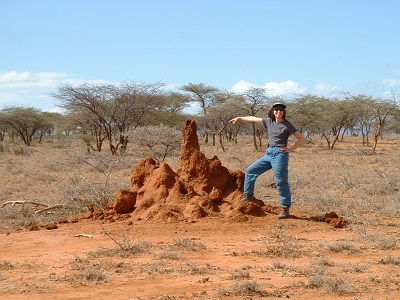
Termites can radically change a landscape.
Termites can generate mounds in the soil that are three stories tall!!!

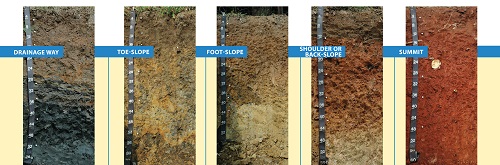
Relief (landscape): The shape of the land and the direction it faces make a difference in how much sunlight the soils gets and how much water it keeps. Deeper soils form at the bottom of a hill because gravity and water move soil particles down the slope.

Soil is different depending on where on a slope it is taken
Soils are different depending on the location in the slope that they are located.

Parent material: Every soil “inherits” traits from the parent material from which it formed. For example, soils that form from limestone are rich in calcium and soils that form from materials at the bottom of lakes are high in clay. Every soil formed from parent material deposited at the Earth's surface. The material could have been bedrock that weathered in place or smaller materials carried by flooding rivers, moving glaciers, or blowing winds. Parent material is changed through biological, chemical and environmental processes, such as weathering and erosion.

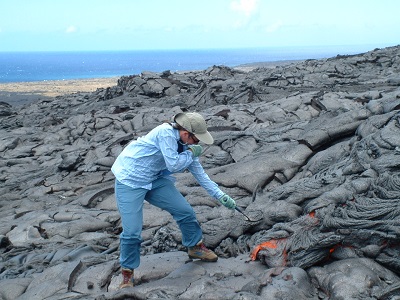
Soil forming at a volcano in real time
These are soils forming in real time from the side of the volcano. They form into rock first, then weather into fertile soil.

Time: All of these factors work together over time. Older soils differ from younger soils because they have had longer to develop. As soil ages, it starts to look different from its parent material. That is because soil is dynamic. Its components—minerals, water, air, organic matter, and organisms—constantly change. Components are added and lost. Some move from place to place within the soil. And some components are totally changed, or transformed.


pipe appurtenances Various pipe appurtenances or fixtures are required to carry out inspections, tests, and cleaning and repairing works on ...