Tuesday, February 04, 2020


Sway and non-sway in frames

A frame is considered to be non-sway (braced) if it is sufficiently braced by lateral bracing elements like structural walls. On the other hand, frames that provide lateral resistance only through columns are considered to be sway frames (unbraced). ACI 318-19 can be used as a reference to distinguish between sway and non-sway frames. It should be noted that purely sway and non-sway frames rarely exist in practice, hence, the design should be prepared based on the requirements. For instance, the designer should decide in advance if the bracing provided by shear walls, elevators, utility shafts, stairwells, or other elements would be sufficient to limit the structure against significant sway effects. It is possible that a particular storey in a structure could be sway while another is non-sway.


Sunday, January 05, 2020

 CANAL IRRIGATION

A canal is an artificial channel that is constructed to carry water to the fields to perform irrigation. The water is taken either from the river, tank or reservoirs. The canals can be constructed either by means of concrete, stone, brick or any sort of flexible membrane which solves the durability issues like seepage and erosion. The distribution system in a canal irrigation system, canal alignment, curves and certain features of canal irrigation are briefly explained in this article. 

Distribution System for Canal Irrigation System

The figure-1 below shows the general layout of a canal distribution system depicting the different networks of canals constituting a canal irrigation system. Whatever be the irrigation scheme i.e direct irrigation using weir or a barrage and storage irrigation scheme like dams or reservoir, both demand a network of irrigation canals of various sizes and capacities. Hence the canal system comprises of:

  1. Main Canal
  2. Branch Canal
  3. Distributaries or major distributaries
  4. Minors or minor distributaries
  5. Watercourses


Canal Alignment

The canal alignment is selected based on the following considerations:

  1. Canal alignment must be chosen such that the maximum area is served with the least length. It also must minimize the use of cross-drainage works.
  2. If the length of the canal is short, there is less head loss, seepage loss, and evaporation loss. This also brings additional areas for irrigation.
  3. Following a straight alignment helps to reduce the loss.
  4. Always a canal alignment with less cross-drainage work must be chosen.
  5. The canal must not pass through forest, town, village or costly areas reducing the chance of giving heavy compensation.
  6. Among different canals, ridge canals help to irrigate either side of the canal.
  7. It must help reduce heavy cutting and filling i.e costly embankment construction must be avoided.
  8. It is recommended to attain a balance in depth of cutting and depth of filling.
  9. The selection of alignment over brackish, rocky or cracked strata must be avoided.

Curves in Canals

It is always recommended to align the canals without curves. Curves result in disturbance of flow. This scours the outer side of the canals and results in silting in the inner curves.In order to avoid, scouring in the concave side, it is required to provided pitching. The canal curves must be more gentle and posses more radius in order to take large discharges.

Advantages of Canal Irrigation

The main advantages of canal irrigation are:

  1. Development of un-irrigated wasteland.
  2. Dangerous droughts can be avoided that expedite economic development.
  3. The water requirement of crops during fluctuation in rainfall intensity can be met by having a proper irrigation system.
  4. Compared to conventional watering, higher productivity per hectare land is obtained due to canals.
  5. The canals constructed are permanent that require regular maintenance.
  6. Canal irrigation does not let the water table level go down. It only helps to increase the water level thus facilitating the digging of wells.
  7. Canals also serve the purpose of hydroelectricity, drinking water supply, fishery development, and navigation.

Disadvantages of Canal Irrigation

The major disadvantages of canal irrigation are:

  1. Any imbalance in the water distribution process results in a scarcity of water in some areas and water clogging in other areas. This hence makes the soil unproductive due to the movement of harmful underground salts and alkalies to the surface level.
  2. Water present stationary in the canal results in the growth of worms, mosquitoes, and insects.
  3. Improper maintenance results in the collection of sediments in the canals that in turn affects the capacity of the canal.
  4. Canal construction demands economic investment and time. Hence, this is not a solution for all irrigation.


Tuesday, December 17, 2019

Floating Foundation

Floating Foundation Prepared by Mr.Bright 

A floating foundation is a type of foundation constructed by excavating the soil in such a way that the weight of the structure built on the soil is nearly equal to the total weight of the soil excavated from the ground including the weight of water in the soil before the construction of the structure. The floating foundation is also called a balancing raft and causes zero settlement to the structure.  


Saturday, November 09, 2019


AIR POLLUTION

Cleaner Air– The Road to a Healthier Future ( CAFS) is a national cross-government strategy that sets out how the Scottish Government and its partner organisations propose to reduce air pollution further to protect human health and fulfil Scotland’s legal responsibilities as soon as possible. A series of actions across a range of policy areas are outlined, and there are a number of important new initiatives:

·        a National Modelling Framework;

·        a National Low Emission Framework:

·        adoption of World Health Organization guideline values for particulate matter in Scottish legislation; and

·        proposals for a national air quality awareness campaign.


What is air pollution?

Air quality can be defined as ‘a measurement of the pollutants in the air’  whilst air pollution is the ‘contamination of air by harmful gases and particulates, mainly oxides of carbon, sulphur, nitrogen and particulate matter’  . Today, we do not usually see factory chimneys, houses or vehicles belching out black smoke. This is because of the increasingly strict legislative controls of industrial and domestic emissions, along with higher engine emissions standards for road vehicles.

Air pollutants may now be largely invisible, but the gases and particulates can be harmful to human health and the natural environment. We are not yet fully compliant with EU and Scottish legal requirements for air quality, as summarised in the Legislation and Policy  and Standards  sections of the Air Quality in Scotland website. As a result, the Local Air Quality Management ( LAQM) regime has designated over 30 Air Quality Management Areas in Scotland.

Reasons for non-compliance with legal objectives include:

·        an increase in the diesel fleet over the last decade;

·        an increase in the total number of vehicles since 2004 [5] ;

·        a disparity between laboratory and real-world emissions from vehicle engines;

·        topography and spatial planning of urban areas creating street canyons, which can trap air pollution close to ground level;

·        limited integration of air quality with other policies related to climate change and planning; and

·        transboundary emission sources.

Air pollution disproportionately affects the most vulnerable members of society, including the very young, the elderly, people with existing medical conditions and those living in deprived urban areas. Thus, the key aims of reducing air pollution are to protect human health and eliminate health inequalities, in addition to improving the quality of places and habitats in the wider environment.

In the UK, the health impacts of poor air quality have been estimated to cost around £15 billion per year  . In the UK, the total economic costs of air pollution may be as high as £54 billion a year  . In Scotland in 2010 fine particulate matter was associated with around 2,000 premature deaths and a total of around 22,500 life years lost across the population  .

CAFS will address the major air pollutants that affect human health (and take account of greenhouse gases such as CO 2), but there will be a focus on two pollutants: nitrogen dioxide ( NO 2) and particulate matter ( PM 10 and PM 2.5).


Multiple benefits of cleaner air

Cleaner air provides multiple benefits, but the responsibility for delivering cleaner air rests with many groups, including the general public, national and local government and businesses. Actions that can be undertaken by individuals and society to achieve cleaner air – and tangible personal benefits – are summarised in Figures. There are also opportunities to generate efficiencies and cost savings by linking air quality to related policy interventions, notably climate change adaption and mitigation plus noise. Efficiency gains of €2.5 billion could be achieved in the EU  through such an approach.


Air quality and Scottish Government policy

Scotland’s Economic Strategy  states that sustainable economic growth is the key to unlocking Scotland’s potential. The Scottish Government’s commitment to sustainable development is reflected in its Purpose  , which is to focus government and public services on creating a more successful country, with opportunities for all of Scotland to flourish. This will be achieved by:

·        creating a supportive business environment;

·        achieving a low carbon economy;

·        tackling health and wellbeing and social problems;

·        maintaining a high-quality environment; and

·        passing on a sustainable legacy for future generations.

Achieving cleaner air in Scotland will deliver positive outcomes across all of these goals.


Tuesday, November 05, 2019

Construction Equipment


Construction Equipment Prepared by Mr. Praveen J

Every construction project has a perfect set of machinery to get the job done. Getting the right equipment for each project helps with efficiency, safety and build quality. Because of this, it’s essential to be on the same page with your team when it comes to choosing equipment. Some machines have multiple uses, while others are task-specific.

So, if you are interested in construction, here are some construction equipment names you need to know:

Boom Lift


A boom lift is a type of aerial platform used to get workers off the ground to work on an elevated project. This construction lift has a bucket that’s typically large enough for one to two workers to stand in. Wheels or a continuous band of treads are used to make the machine mobile. The crane that lifts the bucket is operated by a hydraulic lift system.

There are two main types of boom lifts: articulating and telescopic, but these are all part of the larger “construction lift” family.

Scissor Lift

Similar to a boom lift, scissor lifts are aerial work platforms used to elevate workers. Both electric and engine-powered scissor lifts exist. Electric scissor lifts are used when a quieter work environment is needed, whereas engine-powered lifts sacrifice quiet for rugged terrain mobility. Scissor lift buckets are elevated by a system of jacks.

3. Forklift


If materials need to be transported a short distance, forklift equipment can be used. The lift can move materials both vertically and horizontally. Usually used in warehouses, it’s operated by a steering wheel and dashboard controls. This equipment is great for loading and unloading heavy packages/materials.

There are ten main forklift types, each with a specific use. For instance, the reach forklift is used to “reach” boxes and other objects at extremely high heights within a warehouse.

4.Man lift


The man lift was created to transport workers between floors of buildings under construction. Typically, man lifts are equipped with four wheels, and most can maneuver around sites. However, these machines are sometimes stationary and have to be moved on a trailer.

Man lifts utilize a bent crane system that uses hydraulic pumps to raise a bucket that workers stand-in during transport. This construction lift is ideal for any project that needs to reach high elevations.

Telehandlers

A telehandler is used for jobs where a forklift is inadequate. It’s more heavy-duty than a forklift and can access much higher areas as well.

These pieces of heavy equipment have an extendable arm, allowing them to place loads in high places. The machine also has large tires, giving it an advantage on off-road sites.

Bulldozer

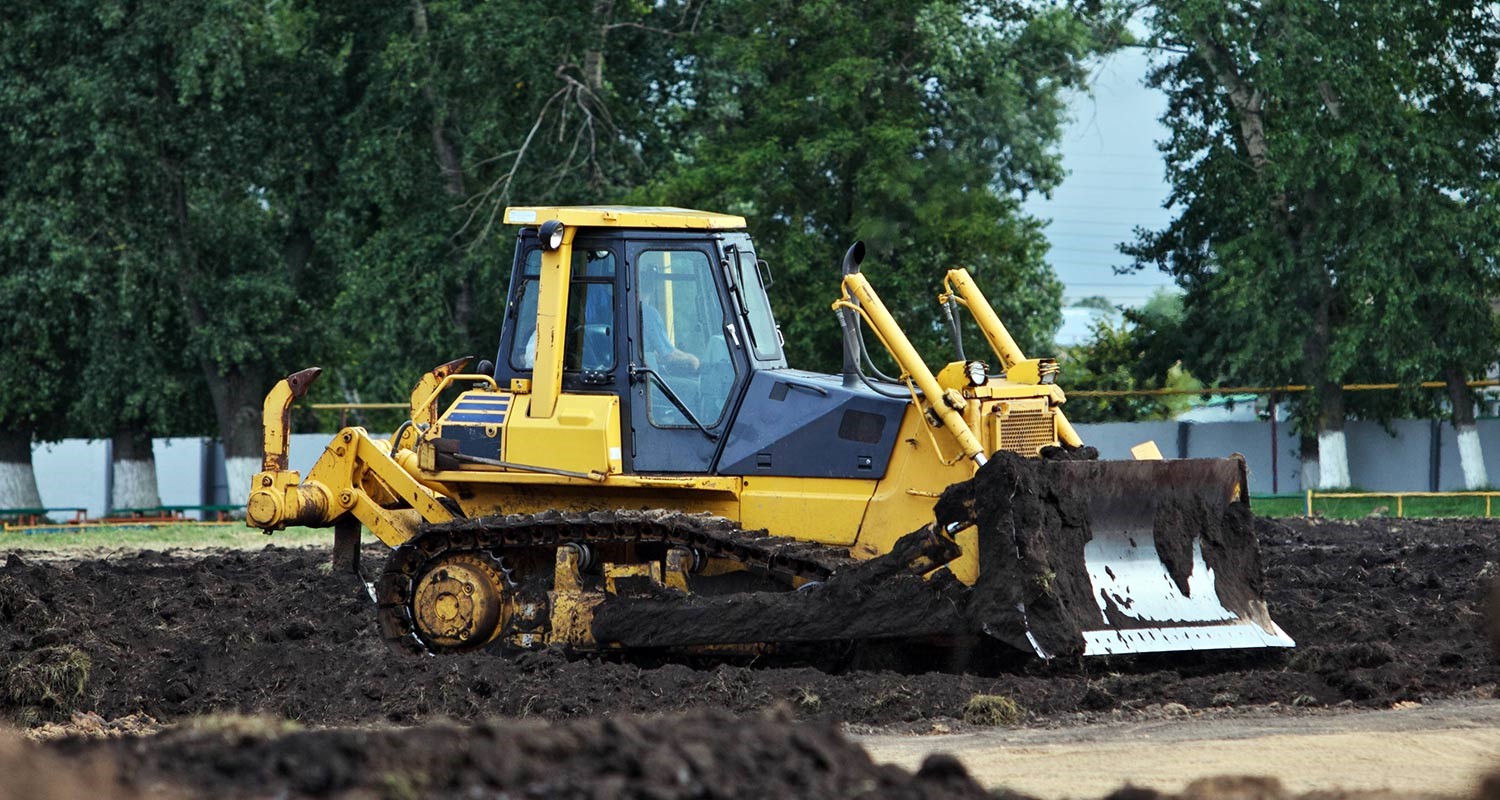
Bulldozers are pieces of crawler equipment and have many different uses. Equipped with a metal bucket plate, this piece of heavy machinery is used to push, carry and condense any sort of loose material on site. The metal plate can also be used to loosen compacted materials and break apart walls or other stable structures.

Wheel Tractor-Scraper


Wheel tractor-scrapers are also used in earthmoving operations. This piece of heavy equipment consists of a rear hopper which can move vertically, with a sharp edge for flattening a surface. The front end hosts a sharp edge to cut soil and a carpenter’s plane for cutting wood. The two tools work together to fill the hopper and transport whatever material was removed from a cleared area.

Skid Steer Loader


Used for a plethora of jobs, a skid-steer loader is a small engine-powered machine. In front of the operating cabin, there’s a mechanism that allows for the attachment of different types of tools.

From buckets to loaders, a skid loader can host different equipment and is also small enough to maneuver into tight areas of a site. The frame is rigid, meaning turning is done through differential steering (e.g., each wheel moves at a different speed, thus causing a turn).

Backhoe Loader


Another type of digger is a backhoe loader. Equipped with a backhoe in the back and a bucket in front, this is a multi-use machine. Similar to a tractor, it’s operated by a driver and has the ability to push materials, with the additional benefit of scooping. Due to its small profile and high maneuverability, the backhoe loader (referred to as backhoe in the industry) is commonly seen in urban environments.

Excavator


An excavator is a heavy piece of machinery used to dig and crush material on a site. It consists of a hydraulic crane-like boom with a metal shovel that has sharp prongs on the end. The driver’s cab is set on a rotating platform, making the machine more maneuverable. The machine is mobile due to an undercarriage consisting of heavy-duty tracks. Although sometimes called a “power shovel,” an excavator and a power shovel have their differences.


Trencher

Trencher are the perfect tool for digging ditches, channels or other long, narrow holes for things like underground piping and cables. This powerful tool is equipped with a heavy metal chain made with incredibly strong steel which it uses to cut into the ground and rip through things like roots, smaller rocks and dirt. They come in a range of sizes and capacities, like the wheel trencher or chain trencher, which looks like a giant chain saw.

Articulated Hauler

As with any articulated truck, an articulated hauler has a pivot joint in its build, giving it increased mobility. Because of this joint, it can carry massive loads around tight turns, making it ideal for most structural builds. This dump truck has a control hub where the driver sits and a material pail where loads go to be transported. Almost all articulated haulers are four-wheel drive, giving them access to most sites regardless of condition.

off-Highway Truck


The off-highway truck is specifically made for rugged environments. This heavy-duty dump-truck has massive wheels with deep treads, allowing it to venture off-road and support construction and mining sites. It’s primarily used to transport materials like rocks or dirt from one site to another. Some models use multi-axle dump buckets to support even heavier loads.

Asphalt Paver


Machines used to lay asphalt are called asphalt pavers. Asphalt is loaded into the paver by a dump truck, and then distributed onto the desired area before being semi-packed down — then they are completely flattened by a roller. The paver is typically towed by a dump truck holding asphalt.

Compactor

While there are many types of compactors in construction, the plate compactor is the most commonly used. It has a vibrating base plate that levels surfaces and crushes uneven debris. Another common compactor is a road rolling compactor.

Road rolling compactors are used to flatten roads in order to prepare them for re-asphalting or to lay foundation. Other common compactors found on construction sites are trash and hydraulic compactors.

Drum Roller

In order to press asphalt, soil and other loose materials, drum rollers are used. This machine is typically found at road construction sites. There are two types of drum rollers: smooth rollers and pad foot rollers.

Smooth rollers provide static pressure and use vibration to compact loose materials. Pad foot rollers, also known as Sheep foot rollers, also provide static pressure and vibration; however, they also generate manipulative force, allowing for uniform compaction.


Wednesday, October 09, 2019


ESTIMATION METHODS USING SOFTWARE

Cost Estimation RCC Building Excel Sheet In order to determine the rate of a particular item, the factors affecting the rate of that item are studied carefully and then finally a rate is decided for that item. This process of determining the rates of an item is termed as analysis of rates or rate analysis. There are numerous methods of estimation. in order to make the work easier software are used in building estimations.


Wednesday, October 02, 2019


FLOATING FOUNDATION

A floating foundation is a type of foundation constructed by excavating the soil in such a way that the weight of structure built on the soil is nearly equal to the total weight of the soil excavated from the ground including the weight water in the soil before the construction of structure. Floating foundation is also called balancing raft and causes zero settlement to the structure.


Principle of Floating Foundation

The main principle of floating foundation is to balance the weight of removed soil by a structure of same weight which causes zero settlement to the structure. So, this foundation is also called as balancing raft foundation.


Let’s consider a ground with water table at the top as shown in the above picture. The ground is excavated up to certain depth which is below water table. Now in the next step, a building is constructed which is as same weight as of the removed soil and water.

Even the depth of excavation is below the table the total vertical pressure in the soil below the foundation is unchanged because of its balancing weight. But here one point is to be noted that we cannot build a structure immediately after the excavation.

During the time of construction, the effective vertical pressure under the depth of excavation may slightly increase because of unbalancing weight. So, this type of foundations can also be called as partly compensated foundations instead of fully floating or compensated foundations.

Suitability of Floating Foundations

Floating foundations are desirable for the following types of soils:

  • Soils which are having good shear strength but having a problem of large settlements and differential settlements under heavy loads. In which case, floating foundation can reduce the settlement values to greater extent.
  • Soils which are having low shear strength and there is no hard layer of soil at reasonable depth. Here also, floating foundation helps to reduce the shear stresses to satisfactory level and hence settlement is prevented.

Difficulties in Construction of Floating Foundation

During the construction of floating foundation some problems may arise which can be prevented by taking proper care. The problems will arise during

  • Excavation
  • Dewatering
  • Critical depth
  • Bottom heave

Excavation

The excavation for floating foundation should be done carefully. The walls of excavated part should be supported using sheet piles or timber piles or soldier piles etc.


Dewatering

If the depth of the excavation is below the water table then dewatering is essential. It is better to examine the water table level prior to the excavation. Dewatering should be done cautiously otherwise it may cause lowering of water table which disturbs the adjoining structures.


Critical Depth

If the soil is of low shear strength as specified above, there is a limit to the depth of excavation which is known as critical depth. There are two equations are available to determine critical depth of excavation given by Terzaghi and Skempton respectively.

1) Terzaghi equation for the critical depth is:

Where,

Dc = critical depth

s = shear strength of soil

B = width of foundation (if width is less than length of foundation “L”)

soil-unit-weight = unit weight of soil

2) Skempton’s equation for critical depth is

Skempton’s equation for critical depth

Where Nc = Skempton’s bearing capacity factor.

By using any one the above two equations, the critical depth or maximum depth of excavation can be determined.

Bottom Heave

When the soil is excavated up to some depth, the pressure of the soil below this depth is lowered which results the formation of heave. The formed heave causes settlement to the structure or foundation. We cannot prevent the formation of heave but there are some methods to minimize the formation of heave.


Excavating narrow trenches and filling them with concrete soon after the excavation minimizes the heave formation. Installing friction piles before excavation or after the completion of half excavation can also prevents the formation of heave. By lowering water table also, it can be minimized. To prevent the heave formation in the side walls of excavated trench, lateral supports should be provided.


pipe appurtenances Various pipe appurtenances or fixtures are required to carry out inspections, tests, and cleaning and repairing works on ...